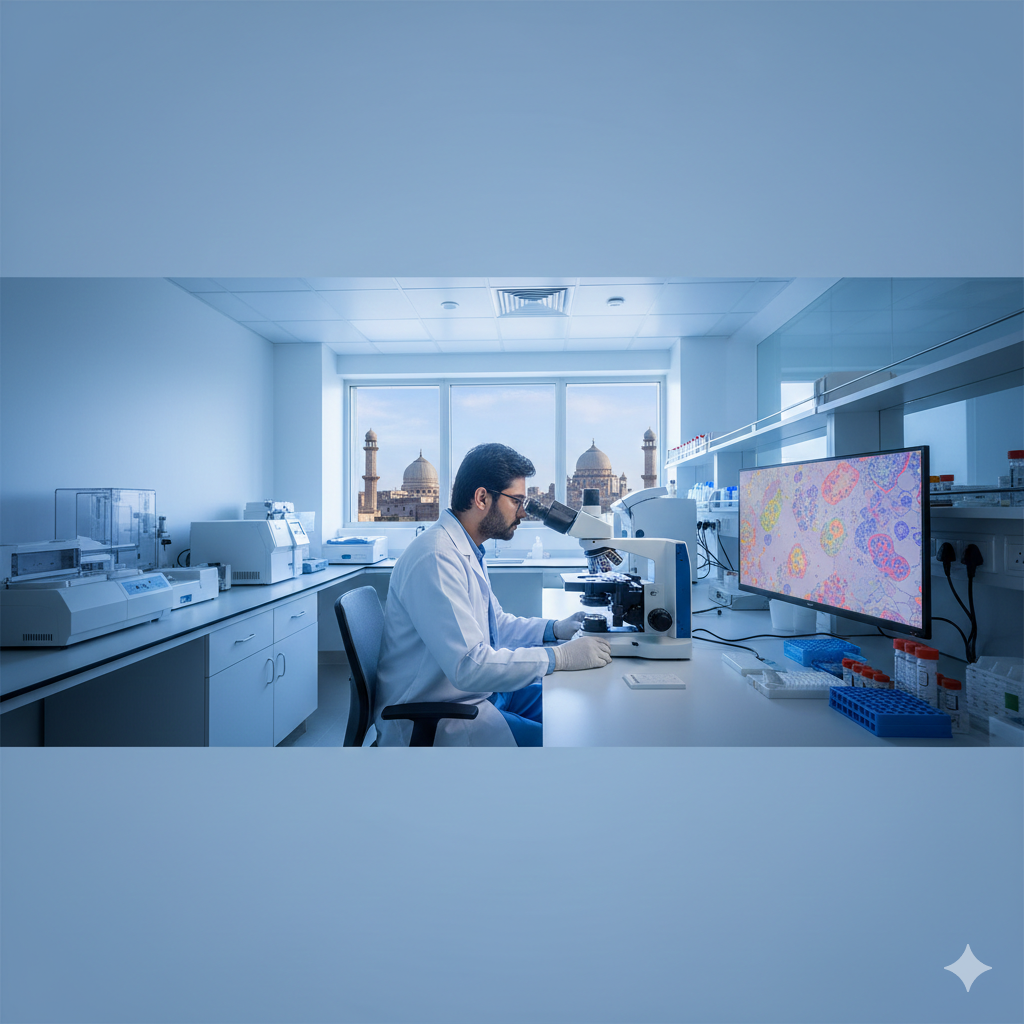
Accurate diagnosis is essential for effective treatment, especially when dealing with suspicious lumps, fluid collections, or possible cancer. In recent years, a modern laboratory method called the Cell Block Technique has become an important tool in pathology and cancer diagnosis.
For patients in Multan and across South Punjab, this technique offers clearer results, better accuracy, and improved disease detection. At Ghazi Lab & Diagnostic Center, Nishtar Road, Multan, cell block analysis is supported by experienced pathologists and modern laboratory facilities.
What is the Cell Block Technique?
The Cell Block Technique is an advanced laboratory method used to process fluid or FNAC samples into a solid tissue-like block. Instead of just examining loose cells under a microscope, the cells are preserved, concentrated, and embedded in paraffin wax, similar to a traditional biopsy sample.
This allows pathologists to study the structure of the cells in greater detail and perform additional tests if needed. Because of this, cell block is especially useful in cancer diagnosis.

Why is Cell Block Important for South Punjab?
In South Punjab, many patients present with late-stage diseases because of delayed diagnosis or limited access to advanced testing. Cell block technology helps bridge this gap by providing more reliable results from small samples.
It is particularly helpful in:
-
Detecting cancer early
-
Confirming unclear FNAC results
-
Differentiating between benign and malignant conditions
-
Reducing the need for repeat procedures
-
Guiding doctors toward the right treatment
For people in Multan, Khanewal, Lodhran, Vehari, Bahawalpur, and Rahim Yar Khan, access to this technique can make a significant difference in medical outcomes.
How is the Cell Block Made?
The process usually follows these steps:
-
A fluid sample or FNAC aspirate is collected from the patient.
-
The sample is sent to the pathology laboratory.
-
Cells are separated from the fluid and concentrated.
-
They are embedded in paraffin wax to form a “cell block.”
-
Thin slices are cut and stained for microscopic examination.
At Ghazi Lab & Diagnostic Center, Multan, trained technicians and pathologists ensure high-quality processing of every sample.
Cell Block vs. FNAC — Explained Simply
FNAC is excellent for initial screening because it is quick and minimally invasive. However, it examines only loose cells, which sometimes makes interpretation difficult.
Cell block, on the other hand, preserves the cells in a structured form, similar to a biopsy. This allows pathologists to:
-
See cell arrangement clearly
-
Perform special stains
-
Conduct additional tests like immunohistochemistry (IHC)
In simple words: FNAC tells us “something is wrong,” while Cell Block helps confirm “exactly what is wrong.”
Conditions Diagnosed Using Cell Block
Cell block technique is commonly used for:
-
Pleural fluid (fluid around lungs)
-
Ascitic fluid (fluid in abdomen)
-
Thyroid nodules
-
Breast lumps
-
Lymph node swellings
-
Cystic lesions
-
Suspected cancer cases
In South Punjab, where tuberculosis and cancer-related fluid collections are relatively common, cell block plays a crucial diagnostic role.
Benefits of Cell Block Technique
This method offers several advantages:
-
Higher diagnostic accuracy
-
Better cancer detection
-
Fewer repeat procedures
-
More detailed analysis
-
Compatibility with advanced tests
-
Cost-effective compared to surgical biopsy
For patients in Multan, this means better results with less discomfort.
Who Should Consider Cell Block Testing?
Doctors may recommend cell block analysis if:
-
FNAC results are unclear
-
There is fluid accumulation in the body
-
Imaging shows a suspicious mass
-
Cancer is suspected
-
Biopsy is difficult or risky
Timely testing can help avoid delays in treatment.
Why Choose Ghazi Lab & Diagnostic Center, Multan?
Located on Nishtar Road, Multan, Ghazi Lab & Diagnostic Center provides:
-
Modern pathology services
-
Experienced specialists
-
Hygienic laboratory environment
-
Accurate and reliable reporting
-
Affordable diagnostic testing
-
Patient-friendly care
Patients from all over South Punjab trust this center for advanced diagnostic techniques like cell block analysis.
Conclusion
The Cell Block Technique represents a major advancement in diagnostic pathology, offering clearer, more reliable results from small samples. For patients in Multan and South Punjab, this modern method improves early detection of serious diseases, especially cancer, and helps doctors plan the best treatment.